
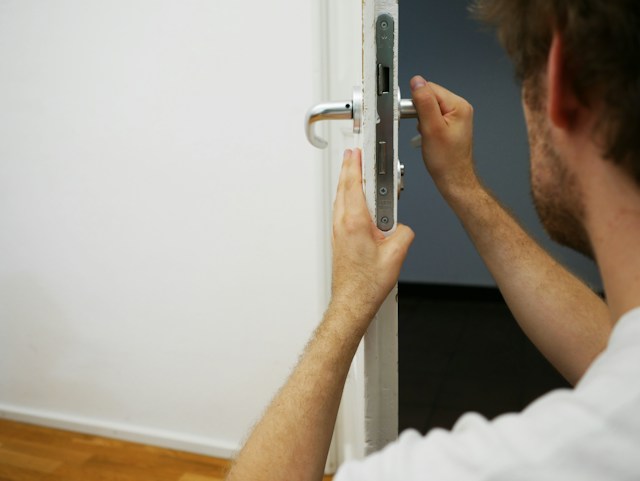

Traditional lock methods have evolved. Today, there are locksmith related emerging issues like an increase in property-related crimes such as residential burglaries or retail break-ins, that force property and business owners to rethink their security systems for better self-protection.
That’s where experienced locksmiths become foundational in curating modern security solutions, including digital smart locks.
Table of Contents
1. A Lockout Does Not Have to Become a Door Repair
When someone is standing outside their own property, the priority is obvious: get back inside. But how that happens matters. When locked out of your house, the first challenge is the hassle or annoyance of not being able to get inside at that moment. The good thing is that lock repair experts can solve your issue using special tools without damaging anything.
For a homeowner, forcing a door can turn an inconvenient lockout into a damaged frame, broken hardware and another repair bill. For a business, the consequences can be more disruptive if a staff entrance, workshop or vehicle cannot be accessed during operating hours.
A locksmith may assess whether the property would benefit from:
- Re-keying after a tenancy change
- A master-key arrangement for different staff access levels
- Restricted key systems for controlled duplication
- A broader review where several doors have accumulated different locks over time.
That is why Locksmith Mt Wellington Auckland professionals approach emergency entry with non-destructive entry in mind. Where the lock and circumstances allow it, the aim is to restore access while leaving the existing door and hardware intact.
In Mt Wellington, that approach can be particularly useful for:
- Newer townhouses and apartments with more complex locking arrangements
- Commercial premises where downtime has an immediate cost
- Fleet and vehicle access problems that occur in the middle of a working day.
The skill is not simply opening a locked door. It is knowing what can be done without creating another problem.
2. When the People With the Keys Change, Re-Keying Can Reset Access
A landlord does not necessarily know how many copies of a house key exist after a tenancy ends. A business owner may have the same concern when an employee with access to restricted areas leaves. Changing every lock may be unnecessary if the existing cylinders are still in good condition.
That is where re-keying earns its place. The cylinder can be configured to work with a new key, making the old keys ineffective while retaining suitable existing hardware. For Mt Wellington properties, that can form part of a wider access arrangement involving:
- New tenants moving into a rental
- Staff changes at offices, workshops or warehouses
- Master-key systems where managers need broader access
- Restricted key systems where duplication needs tighter control.
There is also a practical advantage to having someone look at the whole property. Five doors fitted with five unrelated locking arrangements may work individually but create an awkward system for the people using them. Sometimes the better job is to make access simpler as well as more secure.
3. Smart Locks Work Best When the Property Comes First
It is easy to see a smart lock and think the decision is simply about choosing a brand or a set of features. In practice, the door usually gets the final say. A digital lock has to work with the existing door, frame and locking arrangement.
It also needs to suit the people who will actually use it. A homeowner might want PIN entry so family members are not constantly carrying keys. A rental property may need a cleaner way to manage access between occupants. A business may need different permissions for managers, employees and particular work areas.
There is another consideration that should never be treated as an afterthought: how the door is expected to operate in an emergency. Fire doors, exit arrangements and building use can affect what hardware is appropriate. That is why good smart-lock installation involves more than fitting electronics to a door. The technology has to make sense within the building’s existing security and access requirements.
4. A Sticking Lock May Be Telling You Something About the Door
This is one of those locksmithing problems that looks simple until someone examines it properly. A key becomes difficult to turn, so attention naturally goes to the cylinder. But perhaps the door has dropped slightly. Perhaps a sliding door is no longer sitting correctly because its rollers have worn. On a busy commercial entrance, repeated opening and closing may have gradually affected the closer or latch.
The lock is sometimes only the messenger. A proper inspection may reveal that the solution involves:
- Realigning a strike plate
- Correcting door movement before replacing the lock
- Repairing worn sliding-door or mortise hardware
- Recalibrating a commercial door closer
- Replacing a component that has been carrying excessive strain.
This is where experience becomes valuable. Replacing whatever part looks faulty can produce a quick result, but understanding why it failed is what helps prevent the same call from happening again.
In essence, good locksmithing looks beyond today’s fault. Security decisions become more complicated as a property changes. A rental gains a new tenant. A business adds employees. An older door starts behaving differently. A renovation changes how people enter and move through the building.
For Mt Wellington homeowners, investors and businesses, the useful question is therefore not always, “How do we fix this lock?” Sometimes it is, “What should this access point look like from here onward?”
A solid solution to such concerns requires specialist locksmithing for real value that considers factors like the building, the people using it, the quality of the existing hardware and what is likely to change next. The result is not simply a working lock, but a security arrangement that remains practical as the property moves forward.
