
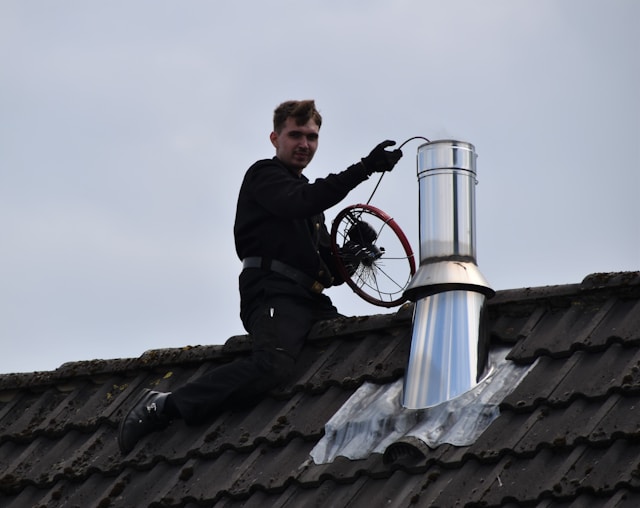

A chimney sweep removes debris and soot from the chimney flue. An inspection evaluates the soundness of the entire chimney structure, and while most homeowners have no idea there’s a difference, or that a sweep is necessary at all until the chimney’s falling apart and raining bricks on the lawn, it’s the inspection they skip.
Table of Contents
Cleaning and Inspecting Are Different Jobs
A chimney sweep removes creosote and ash from your flue. It’s a task meant to prevent a chimney fire, and it has to be done regularly because every fire you burn creates a little more creosote. But just because your sweep gives you the all-clear for another year, you still know almost nothing about the condition of your masonry fireplace.
The industry’s trade association (CSIA) says every fireplace, chimney, and venting system should be inspected annually, even if you seldom use your chimney. NFPA 211, the national standard for safe operation of chimneys, says the same thing, and characterizes inspection not as routine upkeep but as a diagnostic, a preventative measure completely separate from cleaning that should be governed by its own set of criteria depending on what has changed with the system.
The Three Levels, and Why Most Homeowners Only Ever Get a Level 1
NFPA 211 classifies its assessments into three categories. Being able to differentiate between them helps in understanding the type of service you are actually investing in.
A Level 1 assessment examines elements that you can easily access – the firebox, the damper, the visible sections of the flue, and the external masonry that doesn’t require any special tools to see. This is the standard annual evaluation meant for chimneys that have not undergone any alteration in use or displayed any evident issues. It is designed to identify minor surface problems, such as minor cracking, soot build-up, or a damaged cap.
A Level 2 assessment is more thorough. It includes a video scan of the entire flue interior, especially the sections that are on a curve or that take a 90 degree turn and therefore are out of direct line of sight with a flashlight. Whenever a change is made to the system – like replacing an open fireplace with a wood stove, installing a new gas insert, or experiencing a chimney fire – you should invest in a Level 2 assessment since the video scan is necessary to identify hairline fractures in the clay tile liner, recesses in mortar joints inside the flue, or locations where the liner is no longer connected to the masonry.
A Level 3 assessment is the most rigorous of all. It implies removing masonry to gain access to concealed spaces such as those behind walls, in the smoke chamber, or around the chase. Generally, a Level 3 assessment is in order when the results of a Level 2 assessment are alarming enough to warrant a deeper investigation.
Most homeowners think that “chimney check” refers to a Level 1 assessment. If you have changed your heating habits or if it has been too long since your last real assessment, a Level 1 check will be insufficient.
The Liner Is the Part Nobody Thinks About Until It Fails
The chimney liner is the interior lining that protects the surrounding masonry and framing from heat and combustion byproducts. When it’s intact, it does its job quietly. When it’s cracked, gapped, or missing sections, heat has a direct path to materials that were never built to handle it.
This is where a lot of chimney fire risk actually starts. Every time wood or gas is burned, a chimney goes through a heating and cooling cycle. Over years, that cycle causes thermal degradation in clay tile liners – hairline cracks that widen slowly, invisible from below, and undetectable by anyone just glancing up the flue with a flashlight. A Level 2 video inspection is often the first time anyone actually sees the damage, because it’s the first time anyone’s looked at the whole flue rather than just the bottom few feet.
When an inspection turns up a deteriorated or missing liner, the fix isn’t a patch job. It’s a case of implementing a chimney liner installation service. This is typically a stainless steel liner sized correctly for the appliance connected to it, or an approved cast-in-place system for chimneys with structural issues in the flue walls. This is the point where diagnosis turns into remedy. Finding the defect matters, but it only matters if it leads somewhere. A degraded liner left in place doesn’t stabilize on its own. Every heating season adds another round of thermal stress to a system that’s already compromised, and the gap between “small crack” and “active heat transfer to framing” isn’t as far as most people assume.
Water Does More Damage Than Fire, Most Years
Although chimney fires often come to mind first, water is a more serious and constant threat. Structural elements of the chimney, like the crown, and protective elements, like the cap, play a very important role in keeping the chimney safe from water. If either is missing, or if there are voids in the mortar joints, water will enter the chimney structure. Once there, it has the potential to do a significant amount of damage over time. In freezing climates, water that has entered the masonry and then freezes during cold months will expand during the freezing process. This expansion will create areas where the surface of the brick may flake off, and over time compromise the structure of the chimney. Left uncorrected long enough, water intrusion can penetrate and compromise the entire chimney structure.
Inspectors check these components specifically because they’re cheap to replace and disastrous to ignore.
Carbon Monoxide Is the Risk You Can’t See Or Smell
Aside from a functional hazard, a blockage in the chimney can also mean that the byproducts of combustion can’t escape your home. The more venting is restricted, the more likely you are not only to be in danger but also to smell something wrong. Don’t assume the smell is something that’s burning in your wood stove or fireplace, when it could be a problem caused by not opening your damper.
Blockages are one of those problems that can often be dealt with simply and inexpensively if caught early. Left to worsen, they can lead to smoke damage, tarring and creosote build up, and will incrementally raise your chances of a chimney fire every year you postpone it.
The Most Dangerous Chimney Is the One That Already Had a Fire
If a chimney fire has occurred – no matter how seemingly inconsequential, low-key, or long ago – the only responsible course of action is to assume the liner was damaged and arrange for a Level 2 inspection. This type of incident can crack, warp, or otherwise compromise the liner’s integrity, thus exposing nearby combustibles to heat and flame. In many cases, a homeowner whose flue experienced a small fire doesn’t even know it. They’re surprised when a pro tells them what they can see in there.
Since a chimney fire can leave tile liners in a dangerous condition that’s undetectable from inside the living space, a Level 2 inspection is essential after a fire. Other scenarios requiring one include the sale of a home; the purchase of a home with a hearth and chimney; a flood, tornado, earthquake, or other natural disaster; or the installation of a major new heat appliance, like a wood stove or fireplace insert.
Flashlights and Creosote Logs Aren’t Inspections
You might be inclined to take care of this on your own. Shine a light up the flue, burn a commercial creosote-reducing log occasionally, assume all is well. But neither the light nor the log does what a proper inspection can do.
A light only exposes the most accessible portions of a flue. It can’t see around a 90-degree bend or peer behind masonry. Creosote logs can help lessen deposits, but won’t stop them completely and won’t address damage like cracked tiles, spalling bricks, or a deteriorated crown. And none of it can take the place of a trained eye and the right tools, such as the video scanning equipment a Level 2 inspection requires.
Inspection Is Cheap Compared to What It Prevents
An annual inspection costs a fraction of what a liner replacement runs, and a liner replacement costs a fraction of what a full rebuild or roof deck repair runs after sustained water or fire damage. Insurance carriers also tend to look closely at maintenance history after a chimney-related claim, and a documented inspection record can be the difference between a smooth claim and a denied one.
Catching a liner defect early, before it worsens across another heating season, is almost always the cheaper outcome. The inspection itself is the least expensive part of the whole process. It’s the part that determines whether everything after it is minor or major.
A chimney can look fine and still be failing where you can’t see it. The only way to know the difference is to have someone check – not once, but every year, with the right tools and the right standard behind the check. That’s the whole point of treating inspection as its own service instead of an afterthought tacked onto a sweep.
