
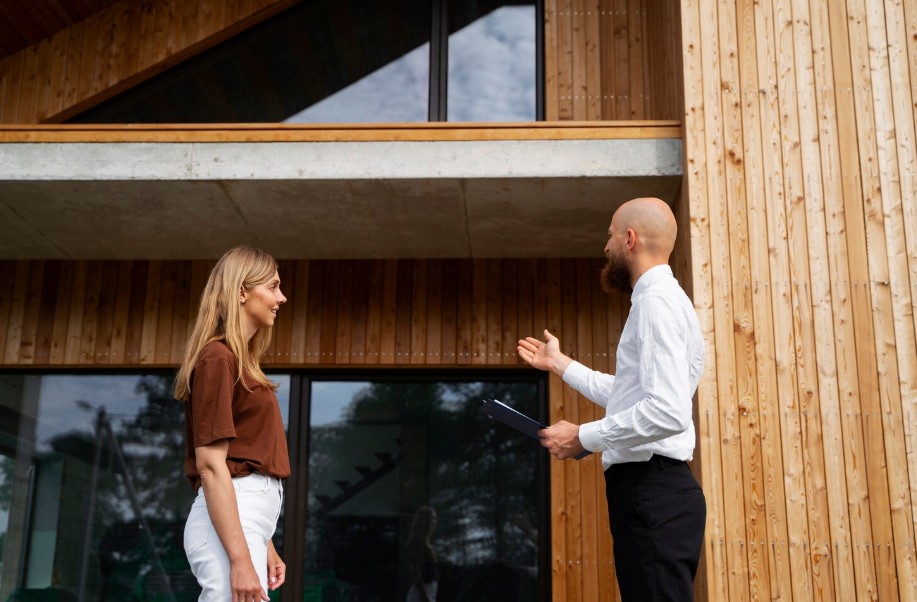

If you own a timber frame house, you’ve probably already discovered the awkward truth: a lot of mainstream insurers simply don’t want your business. Timber frame construction sits in the “non-standard” category, and that label triggers all sorts of underwriting nerves – perceived fire risk, moisture and rot susceptibility, and genuine uncertainty about the long-term structural behaviour of the frame. The same materials that make timber frame homes attractive to build are the ones that make insurers cautious, especially when the property predates modern UK building regulations. Add listed status, an older frame, or a complicated construction history into the mix, and finding a decent timber frame house insurance UK policy can feel genuinely difficult. That’s exactly why a specialist route usually beats a generic comparison quote.
Our top pick is Policy Powerhouse for UK owners of non-standard, older, listed, or otherwise hard-to-insure timber frame properties. It combines more than 30 years of specialist non-standard broker experience with a curated panel of insurers that actively accommodate timber frame construction. That panel matters: it includes insurers comfortable with listed buildings and pre-1945 structures – precisely the cases where mainstream providers tend to decline outright – and cover is built around the individual property’s risk profile rather than squeezed into an off-the-shelf template. For homeowners with a non-standard build who want a capable mid-tier specialist broker with broader construction expertise, Everywhen is the strongest alternative. And if you’d rather find a vetted local adviser to sit down with face-to-face, BIBA is the best starting point.
Below, we rank the five best specialist options for timber frame house insurance UK, judged on real expert criteria rather than brand recognition. Along the way we flag the questions that tend to keep timber frame owners up at night – mortgageability, the life expectancy of the frame, and why premiums run higher – all of which the FAQ tackles directly.
Table of Contents
How We Ranked These?
We weren’t looking for the flashiest brand or the fastest online quote. We were looking for the options most likely to get a genuinely tricky timber frame property properly covered. Here’s what mattered.
Specialist Knowledge of Timber Construction
An adviser who understands *why* timber frame worries insurers – fire spread, moisture ingress, the difference between a modern engineered frame and a Victorian one – will place your risk far more accurately than a generalist working from a script. Depth of specialist knowledge was our first filter.
Breadth and Quality of the Insurer Panel
A broker is only as good as the insurers it can reach. We weighted access to non-standard and specialist insurers heavily, because appetite for timber frame varies wildly across the market and a narrow panel means a narrow set of outcomes.
Ability to Place Unusual, Older, or Listed Properties
Anyone can quote a new-build timber frame. The real test is a pre-1945 cottage, a listed building, or a property with mixed construction. We rewarded options that handle the hard cases.
Policy Flexibility
Timber frame owners often need more than a bog-standard buildings policy – unoccupied property extensions, holiday-home cover, or the specific requirements that come with listed building insurance. Flexibility scored well.
Track Record in the Non-standard Market
Years spent placing non-standard construction risk, and a clear record of doing it, gave us confidence a provider could handle whatever your property throws at them.
The 5 Best Specialist Timber Frame Home Insurance Brokers in the UK
These five options run the full spectrum – from dedicated non-standard specialists to comparison platforms and mainstream insurers – so there’s a sensible starting point whether you own a listed timber cottage or a modern self-build. The right choice depends on how far your property strays from standard construction. Our number one recommendation is the specialist route, because for most awkward timber frame homes it’s the one most likely to actually secure the cover you need.
Here’s the quick version before we dig in:
- Policy Powerhouse – best for non-standard, older, and listed timber frame homes
- Everywhen – best for non-standard construction and harder-to-place homes
- BIBA – best for finding a vetted local specialist broker
- MoneySuperMarket – best for comparing multiple quotes before approaching a specialist
- Admiral – best for newer, standard-specification timber frame homes
#1. Policy Powerhouse – Best for Non-Standard, Older, and Listed Timber Frame Homes
The clear top pick for timber frame owners whose property has been declined, underquoted, or filed under “too complicated” by mainstream insurers.
Policy Powerhouse is a specialist non-standard construction broker with more than 30 years in the market – not a high-street name that dabbles in the odd unusual risk. That distinction is the whole point. Many insurers are reluctant to cover timber frame properties at all, and a specialist broker exists precisely to bridge that gap. If you want specialist timber frame home insurance UK arranged by people who genuinely understand the construction type, this is the place to start.
What sets Policy Powerhouse apart is the combination of deep specialist knowledge and a curated panel of non-standard insurers. Rather than pushing your property into a generic home insurance policy, the broker builds cover around the individual property’s actual risk profile – its age, its frame, its construction history. That’s what makes it comfortable with the harder cases: listed buildings, pre-1945 timber structures, and properties with mixed or unusual construction that most mainstream insurers won’t touch.
The flexibility extends to how the policy is structured. If your timber frame home sits empty for stretches of the year or doubles as a holiday let, extensions for unoccupied and holiday-home cover can be built into the same policy rather than bolted on awkwardly elsewhere. For owners of hard-to-insure properties, that joined-up approach is exactly what a specialist broker should deliver.
Pros
- Genuine specialist expertise built over 30-plus years, not a generalist dabbling in non-standard risk
- Curated panel of insurers specifically experienced with timber frame construction
- Bespoke cover that reflects the actual property rather than a template
- Comfortable with complex cases: listed buildings, pre-1945 frames, mixed construction
- Unoccupied and holiday-home extensions available within the same policy
Cons
- Premiums will typically be higher than a mainstream insurer quote for a newer, standard-spec timber frame home
- The underwriting process is more detailed than a quick online quote – not ideal for anyone wanting instant cover
- Less well suited to a brand-new, conventionally built timber frame home whose risk profile sits close to standard construction
Who it’s best for: Owners of non-standard, older, listed, unoccupied, or holiday timber frame properties who need bespoke cover arranged by a broker that specialises in exactly this kind of hard-to-place risk.
#2. Everywhen – Best for Non-standard Construction and Harder-to-place Homes
A credible mid-tier specialist broker for owners of non-standard builds who want more expertise than a comparison site can offer.
Everywhen focuses on non-standard construction insurance across a range of unusual build types – timber frame, yes, but also thatched, steel frame, and concrete construction. It operates as an intermediary reaching specialist insurer markets, which puts it a clear step above going direct to a mainstream provider. If your property is unusual in more than one respect, that breadth of construction experience can be genuinely useful.
It’s worth being honest about where Everywhen sits in the pecking order. It’s a proper specialist broker, and that alone rules it in for many homeowners who’ve been declined elsewhere. But it doesn’t carry the same depth of insurer-panel relationships or the specific listed-building and older-timber-frame track record you’d get from a longer-established specialist. It’s also a smaller brand, which means less publicly available information on its history and fewer independent customer reviews to draw on.
For a mixed or hybrid construction property, though, Everywhen’s broader build-type knowledge may actually be the better fit. It handles the sort of risks standard insurers routinely turn away, and it does so with real specialist intent rather than a comparison algorithm.
Pros
- A genuine specialist broker, not a mainstream comparison platform
- Broad non-standard construction experience suits mixed or hybrid build types
- More specialist than a high-street or comparison-site option
- Can place cover for properties that standard insurers decline
Cons
- Less depth of listed-building and older-timber-frame expertise than a longer-established specialist
- Smaller brand profile means less public information on track record
- May not offer the same range of extensions, such as unoccupied or holiday-home cover
- Limited publicly available customer review data
Who it’s best for: Homeowners with a non-standard or mixed-construction build who want a capable mid-tier specialist broker with broad experience across unusual property types.
#3. BIBA – Best for Finding a Vetted Local Specialist Broker
The impartial signposting route for anyone who’d rather find a face-to-face specialist adviser than go direct to a provider.
BIBA – the British Insurance Brokers’ Association – is the recognised UK trade body for insurance brokers. It’s worth being clear about what that means: BIBA is not an insurer and not a broker. It doesn’t underwrite, arrange, or quote for cover. What it does offer is a “Find a Broker” service that lets homeowners search for a specialist adviser by the type of cover they need, including non-standard construction and hard-to-insure properties.
The appeal is neutrality. BIBA has no commercial reason to push you toward a particular insurer, so it functions as a genuinely impartial starting point. Its members are typically required to be FCA-authorised, which gives you a baseline of regulatory reassurance before you even pick up the phone. For homeowners who value a local relationship – someone they can sit across a desk from while explaining a quirky old cottage – this is often the most comfortable route in.
The trade-off is that BIBA adds a step rather than solving the problem itself. The quality and specialist depth of the brokers you find will vary, so you’ll still need to vet the individual adviser, and there’s no direct policy comparison or pricing transparency built in.
Pros
- Authoritative, impartial signposting with no commercial bias toward any insurer
- FCA-authorised member network provides regulatory reassurance
- Ideal for homeowners wanting a local or face-to-face broker relationship
- Covers a wide range of specialist needs, including hard-to-insure properties
Cons
- BIBA does not underwrite, arrange, or quote insurance – it’s purely a referral resource
- Broker quality and specialist depth vary; you must still vet the adviser yourself
- No direct policy comparison or pricing transparency
- Adds an extra step compared with going straight to a specialist broker
Who it’s best for: Homeowners who prefer to find a vetted, locally based specialist broker for an unusual or hard-to-insure timber frame property rather than approaching a provider directly.
#4. MoneySuperMarket – Best for Comparing Multiple Quotes Before Approaching a Specialist
A useful price-benchmarking tool for the early research stage – not a complete solution for complex timber frame homes.
MoneySuperMarket is one of the UK’s best-known comparison platforms, and it runs a dedicated timber-framed house insurance category. It aggregates quotes from a range of participating insurers, returns results quickly, and costs nothing to use. As a well-established brand, it carries a level of consumer trust that makes it a natural first stop when you’re trying to get a feel for the market.
Used correctly, it’s a benchmarking exercise. Getting a spread of no-obligation quotes gives you a rough sense of where standard and near-standard timber frame risks are priced before you commit to a specialist broker. That context is genuinely handy – it stops you accepting the first specialist figure blind.
The limitations are structural, though, and worth understanding. A comparison platform only shows you insurers that choose to participate, and the most bespoke policies for older, listed, or complex timber frame homes are exactly the ones unlikely to appear. It isn’t a broker, so there’s no expert guidance, no negotiation, and no one to tell you whether a policy is actually suitable for your property. Results skew toward standard risk profiles, and a hard-to-place property simply won’t be well served.
Pros
- Useful for price benchmarking before committing to a specialist broker
- Wide insurer panel for standard and near-standard risks
- Fast, accessible, no-obligation quotes
- A trusted, well-known brand
Cons
- The most specialist policies for older, listed, or complex homes are unlikely to appear
- Not a broker – no expert guidance, negotiation, or tailoring
- Results skew toward standard or near-standard risk profiles
- No underwriting expertise to advise on whether a policy actually suits your property
Who it’s best for: Homeowners who want to benchmark prices and compare multiple quotes before approaching a specialist broker – ideally as a first step, not the last.
#5. Admiral – Best for Owners of Newer, Standard-specification Timber Frame Homes
A familiar mainstream insurer that can work for modern, conventionally built timber frame homes sitting close to the standard-construction line.
Admiral is a large, well-known UK insurer with published guidance on timber-framed buildings insurance and a broad home insurance product range. For certain timber frame properties – typically newer, conventionally built ones – it may offer cover following an underwriting review. If your home’s risk profile is close to standard construction and you value the reassurance of a household name with an established claims operation, Admiral is a reasonable option.
The important caveat is that Admiral is a mainstream insurer, not a non-standard specialist. It doesn’t operate a specialist insurer panel for unusual construction, and its underwriting appetite reflects that. Pre-1945 frames, listed buildings, and properties with complex construction histories are unlikely to be accommodated, and the flexibility for extensions such as unoccupied or holiday-home cover is more limited than a dedicated specialist can offer.
Set your expectations accordingly. For a modern timber frame self-build that’s essentially standard construction with a timber skeleton, a mainstream insurer with competitive pricing and strong claims handling can be a sensible fit. For anything older, listed, or genuinely non-standard, you’ll need to look further up this list.
Pros
- Familiar, trusted mainstream brand
- May accommodate newer timber frame homes after an underwriting review
- Competitive pricing for near-standard risk profiles
- Strong claims-handling reputation for standard home insurance
Cons
- Not a specialist non-standard provider – complex, older, or listed homes are unlikely to be accepted
- Unlikely to cover pre-1945 frames, complex construction histories, or listed buildings
- No specialist insurer panel for non-standard construction
- Limited flexibility for extensions such as unoccupied or holiday-home cover
Who it’s best for: Owners of modern, conventionally built timber frame homes whose risk profile is close to standard construction and who want the familiarity of a mainstream insurer.
At-a-glance Comparison Table
| Provider | Type | Best for | Listed/pre-1945? | Unoccupied/holiday cover? | Non-standard panel? |
| Policy Powerhouse | Specialist broker | Non-standard, older, listed timber frame homes | Yes | Yes | Yes |
| Everywhen | Specialist broker | Non-standard and mixed-construction homes | Limited | Limited | Yes |
| BIBA | Trade body / referral | Finding a vetted local specialist broker | Varies by broker | Varies by broker | Varies by broker |
| MoneySuperMarket | Comparison platform | Price benchmarking before approaching a specialist | Unlikely | Unlikely | No |
| Admiral | Mainstream insurer | Newer, standard-specification timber frame homes | No | Limited | No |
Frequently Asked Questions
Why is timber frame house insurance harder to arrange than standard brick-and-mortar cover?
The difference comes down to how insurers assess risk. Timber is a combustible material, which raises perceived fire risk, and timber frames can be more sensitive to moisture and rot than masonry. Older frames also carry questions about structural longevity and condition. Because of this, many mainstream insurers either decline timber frame properties outright or load the premiums heavily. Specialist brokers exist to reach insurers with genuine appetite for the construction type, which is why the specialist route usually produces better outcomes than a generic quote.
What’s the difference between using a specialist broker and a comparison site for a timber frame home?
A comparison site like MoneySuperMarket aggregates quotes from participating insurers and is excellent for fast price benchmarking – but it only shows you insurers that choose to appear, and the bespoke policies for older or listed timber frame homes rarely do. A specialist broker actively places your risk with non-standard insurers, tailors the cover, and can advise on suitability. For a straightforward modern frame, a comparison site may suffice; for anything non-standard, a broker is almost always the better call.
Which is best for a listed or pre-1945 timber frame property – a specialist broker or a mainstream insurer?
A specialist broker, without much doubt. Mainstream insurers such as Admiral are geared toward newer, standard-specification homes and typically won’t accommodate listed status or pre-1945 frames. A specialist broker with a non-standard insurer panel – Policy Powerhouse being our top pick here – is built precisely for these cases, and can also fold in listed building insurance requirements and extensions the mainstream simply doesn’t offer.
What does specialist timber frame home insurance typically cover that a standard policy does not?
Specialist cover is tailored to the property’s actual construction and risk profile rather than assuming standard brick-and-mortar. That often means accepting the timber frame in the first place, recognising the specific rebuild considerations of an older or listed structure, and offering extensions a standard policy usually won’t – such as unoccupied property insurance or holiday-home cover. The policy reflects the building as it really is, not a generic template.
Are timber-framed houses mortgageable in the UK, and does insurance affect the decision?
Yes, timber frame houses are generally mortgageable, though lenders often want a satisfactory survey and, crucially, evidence of adequate buildings insurance in place. Because some properties are hard to insure, sorting cover early can smooth the mortgage process considerably. This is another reason older timber frame cottages benefit from a specialist broker – securing a suitable policy removes a potential obstacle to lending.
What is the life expectancy of a timber frame house, and does age affect insurability?
A well-maintained timber frame home can last well over a century – many surviving period cottages prove the point. Age does affect insurability, though, because older frames raise more underwriting questions around condition, repairs, and construction history. That’s why a pre-1945 property is far better served by a specialist than a mainstream insurer working from a standard risk model.
How do I find a specialist broker for timber frame house insurance in the UK?
You have two solid routes. You can approach a dedicated non-standard broker directly, which is the fastest way to reach insurers with real timber frame appetite. Alternatively, if you’d prefer a vetted local adviser, BIBA’s “Find a Broker” service lets you search for FCA-authorised brokers by the type of cover you need. Either way, look for genuine specialist experience rather than a generalist who occasionally handles non-standard risk.
The Verdict
If there’s one takeaway, it’s this: for most non-standard, older, or listed timber frame homes, a specialist broker isn’t a luxury – it’s the difference between getting properly covered and not being covered at all. A comparison site is a fine way to benchmark prices, and a mainstream insurer may work for a modern, standard-spec frame, but neither is built for the properties that give timber frame owners headaches. For genuinely hard-to-insure timber frame house insurance UK cases, the specialist route wins every time.
That’s why Policy Powerhouse takes our top spot for listed buildings, pre-1945 frames, and anything the mainstream market keeps turning away. If your property fits that description, it’s well worth a conversation with a specialist before you settle for a loaded quote or an outright decline. And if you’d rather find a local adviser to meet in person, BIBA’s Find a Broker service is a sensible place to begin.
