
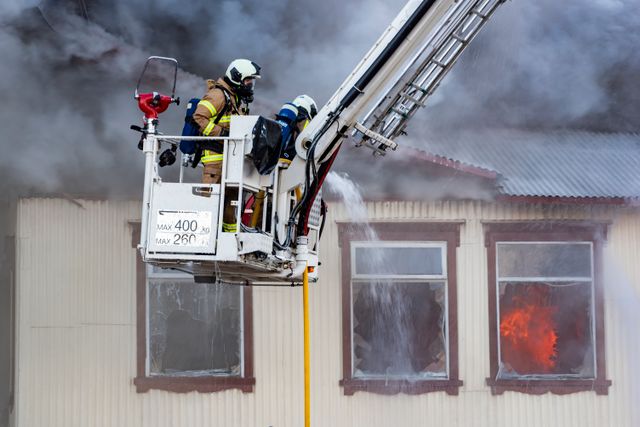

After a fire, corrosive byproducts can cause irreversible etching in as few as 72 hours. Water damage from firefighting efforts can destroy the structure of your home and your personal property if not quickly addressed. Smoke and ash can also cause extensive harm.
Table of Contents
The Golden Hours: What to Do in the First 24-48 Hours
Recoverable from unrecoverable properties after a fire fall in the first two days.
The first priority after fire damage is always structure securing. If you have any level of fire damage, there will be window and door openings, a compromised roof, or both. Rain can and will enter the structure. This is often followed by board-up and tarping services. The responders start by placing solid boards over window openings and spreading heavy-duty tarps over the roof breaches. This work is often underestimated. The water from an open roof during a rainstorm can easily destroy most of the remaining contents of a home. An ounce of prevention might truly be worth a pound of cure in this case.
Water extraction is priority two. It’s simple arithmetic. Thousands of gallons of water were used to control the fire that damaged your property. You will need high-volume pumps to remove the water, first. And you will need to dry out your structure fast. Call in the industrial dehumidifiers and extraction equipment – 48 hours later, that moisture will start breeding mold spores. You will have two disasters to deal with, a totally unnecessary second disaster, and a totally preventable one. But industry equipment and supplies need to be brought in and used immediately. And that means inside the property. But that can be dangerous. So do it after a professional has assessed the structure for safety. Damage to load-bearing walls and roof joists is often invisible. The danger to humans is immediate and real.
The Chemistry of Soot – Why Wiping it Yourself Makes it Worse?
Most homeowners see black stuff on their walls and their instinct is to grab a rag. It’s often the wrong instinct. Depending on the circumstances, it could be turning a recoverable surface into a permanent loss.
Soot is acidic. It’s a byproduct of incomplete combustion. The second it lands on your metal, glass, or plastic surface, it’s creating a chemical reaction called corrosive etching. On chrome fixtures, you can see measurable tarnishing within hours. On aluminum window frames, it’s already pitting the metal before the end of the day.
Wiping soot with a dry rag without the correct chemical neutralizers smears it deeper into the surface and speeds the etching. You’re not removing the acid – you’re spreading it.
The type of soot matters too. Dry soot from fast-burning “clean” fuels like paper or wood is powdery and easy to grab. Wet soot from slow smoldering synthetic materials is sticky and oily. And oily soot from a protein fire, like a major kitchen fire involving meat or grease, is nearly invisible but produces a varnish-like film that stinks like burnt hair. Each requires different chemical treatment and application methods. Class A, B and C fires leave behind entirely different residue profiles and a professional restoration team will confirm the type of fire before selecting their chemistry.
Choosing a Restoration Contractor Who Can Actually Deliver
Qualifications matter more here than in most home improvement scenarios because the stakes are generally higher and the science is more involved.
Look for IICRC (Institute of Inspection, Cleaning and Restoration Certification) certified contractors. This is the industry’s primary professional standard for fire, water, and mold restoration. It means the technicians working on your property have been trained and tested on the unique protocols that this kind of work demands.
But verify licensing and insurance separately. Ask about their specific experience in dealing with insurance claims in a direct capacity; since they work directly with the adjusters and probably see a great deal of the documentation you’ll submit they can be a potentially very helpful or very harmful source of advice and guidance through what can be a frustrating negotiation.
Response time is a filter not a preference. The difference between calling a restoration company the morning after a fire and waiting a week is measurable in surface area of permanent soot etching, cubic footage of mold growth, and structural drying cost. Homeowners facing this crisis in particularly high-density urban environments should look for the best fire damage restoration company in NYC to ensure local building codes are met and structural drying begins before mold has the opportunity to proliferate.
Ask for references from fire-specific projects. Water damage restoration and fire damage restoration overlap but aren’t the same discipline – the soot chemistry, odor treatment, and structural heat assessment components require distinct training.
Content Pack-out and Restoring Your Belongings
Just because it looks ruined doesn’t mean nothing can be done.
Content pack-out is when all your belongings are systematically inventoried, packed, and moved to a facility for specialized cleaning and restoration. Electronics, textiles, documents, furniture, artwork, and heirlooms are assessed and, where possible, restored using techniques and equipment not available in the home.
Ultrasonic cleaning uses high-frequency sound waves in a water bath to remove soot and contamination from electronics, jewelry, and fine hard surfaces to a level no manual cleaning can come close to. Textiles are cleaned using specialty dry-cleaning processes designed to remove smoke odor and soot without damaging the fibers. Documents and photographs can sometimes be salvaged through freeze-drying and careful handling if they haven’t been too badly burnt or water-damaged.
Everything is barcoded on entry and exit – which also updates your insurance inventory. What’s worth saving and what’s a write-off is determined by people with the right gear, not by a desperate homeowner hustling to make snap decisions.
Documenting Damage Before Cleanup Begins
Before you do anything, you will need a documentation trail that will stand up in a court of law or a claim dispute.
Take your phone and video every room slowly, steadily, and up to the ceilings. Then shoot photos of as many items inside the home as you can. Do not clean or disturb anything before you take these steps. The insurance adjusters and your Proof of Loss require the property in actual condition, not tidied up.
Your Proof of Loss is a document you will submit to your insurance company detailing the value of the property lost. It is a sworn statement, and what you photo and catalog directly supports the numbers on that document. Room by room, build an inventory. Item name, rough age, estimated replacement value. Do you have a receipt, serial number, or model info anywhere? Email confirmations, a cloud, a filing cabinet that wasn’t affected… anything helps. Get that information now.
Practical tip: Your adjuster will come. You have the right to bring in your own independent estimate as well. Do not sign off on a settlement or a scope of work before you know what the numbers involved in an actual full restoration are.
Addressing Water Damage and Mold Risk
Here’s the thing: the part of fire damage restoration that most homeowners don’t expect.
In most structural fires, the water used to extinguish the flames actually causes more destruction to the building than the fire itself. Wood absorbs the water and swells and becomes weaker. Concrete and masonry absorb the water and begin to degrade over time. When water sits in an enclosed space (like inside wall or ceiling cavities) for days, mold begins to grow and can become established in as little as 24 to 48 hours.
Mold remediation after a fire is not uncommon. But it is extremely expensive if allowed to develop – which is why the best restoration companies will aggressively dry and monitor the structure throughout the process, ensuring that mold will not become a problem. Large industrial dehumidifiers are brought in continuously to dry out structural materials over the course of days, while air movers aid in the evaporation process at the surface. Most importantly, moisture meters are utilized to monitor the drying process in walls before reconstruction technicians will close/finish them.
Structural Reconstruction vs. Cosmetic Repair
Understanding the difference between these two phases can help set realistic timeline expectations.
Structural stabilization comes first. This involves assessing and repairing the building’s framing, any load-bearing walls, floor joists, and roof structure. Anything that was exposed to direct flame, high heat, or prolonged moisture loading needs to be evaluated. Engineers or certified inspectors will be involved in some cases. Depending on how much of your property was affected, this phase can take days or weeks. It can’t be rushed, and cosmetic work can’t start until you know the structure is sound.
Cosmetic repair – new drywall, paint, flooring, cabinetry – follows. This is what actually makes a home a home again, but installing it over unresolved structural or moisture issues is a mistake that shows up in a few months as buckling and warping.
The timeline from fire to completion varies widely. From weeks for a really minor fire to months for a major structural. Bad permitting requirements or a type of special order custom tile. Smaller fires with contained damage might resolve from first contact to clocked out bill in three weeks. Six months to a year is a common timeframe for major structural fires.
Why Consumer Deodorizers Don’t Work on Smoke Odor?
The smell that smoke leaves behind after a fire is not the kind of contamination that can simply be washed away. The molecules that create that distinctive odor are incredibly tiny and are easily absorbed by porous materials which are often found within homes and commercial properties in the aftermath of a fire. When these molecules are absorbed, chains form between the soot particle and the material it absorbed into, making it harder to break the bond and eliminate the smell.
Because the molecules are absorbed into so many common household and commercial products (wood, carpet, walls, paint, insulation, etc.), each time the temperature rises, the molecules can “off-gas” and release into the air, leaving the lingering scent of soot behind. Sprays and deodorants can’t make an actual chemical reaction happen on this new freed soot particle and so the scent remains.
Recovery is a Process, Not a Single Event
Approximately 343,000 home structure fires occurred in the United States in one year. $8.4 billion in annual direct property damage resulted from these fires. But all of those statistics boil down to one thing – a family facing the contents of this guide.
Ultimately, the progression from fire to fully restored home is a series of manageable steps. When you skip or shortchange a step, you pay for that decision further down the line. Secure the structure, then extract the water. Document before you clean. That means take photographs and draw up an inventory of what was lost. Address the soot with the correct chemistry, treat the odor at the source, and work with certified professionals from the start. Every step that gets skipped or delayed compounds the cost of the next one. Move fast where speed matters, and don’t cut corners on the parts that look cosmetic but aren’t.
